Wireless Infrastructure
Meeting the continually evolving demands for 4G LTE & 5G wireless infrastructure applications with RFHIC's gallium nitride (GaN) on silicon carbide (SiC) technology solutions






The semiconductor industry continues to expand with growing demand from AI, high-performance computing (HPC), 5G communications, and autonomous technologies. As these technologies advance, the need for higher computing performance and data processing capability continues to rise, accelerating the miniaturization and higher integration of semiconductor devices.
This industry trend is placing greater emphasis on precise process control and a stable plasma environment in semiconductor manufacturing. Plasma processes are used in a wide range of critical semiconductor manufacturing steps, including etching, thin-film deposition, and surface treatment, and they are key factors that directly influence process quality and yield.
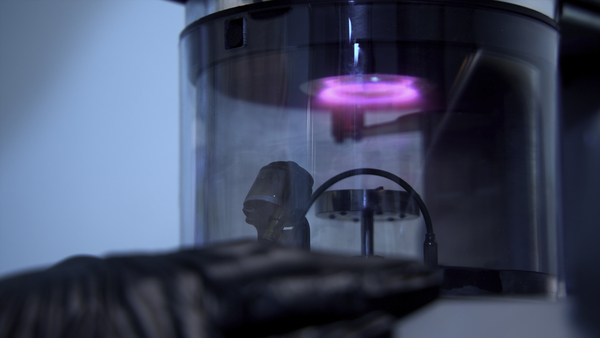
Recently, plasma generation technology using RF microwave generators has gained attention as an alternative for high-precision semiconductor processing. RF microwave equipment delivers microwave energy into process gases to create a plasma state in which electrons and ions are generated, thereby enabling a variety of chemical reactions.
In particular, microwave-based plasma offers high energy coupling efficiency and uniform plasma formation. In addition, this approach can be implemented with low or no electrode dependence, which is advantageous in reducing process contamination and improving equipment lifetime.
As device geometries continue to shrink, plasma density, stability, and repeatability have become even more critical to process performance. In this context, the quality of RF power delivery is no longer just a supporting factor—it is increasingly part of the process window itself. GaN solid-state RF microwave generators are particularly relevant in this context because they enable more stable and controllable RF power delivery for advanced semiconductor processes.
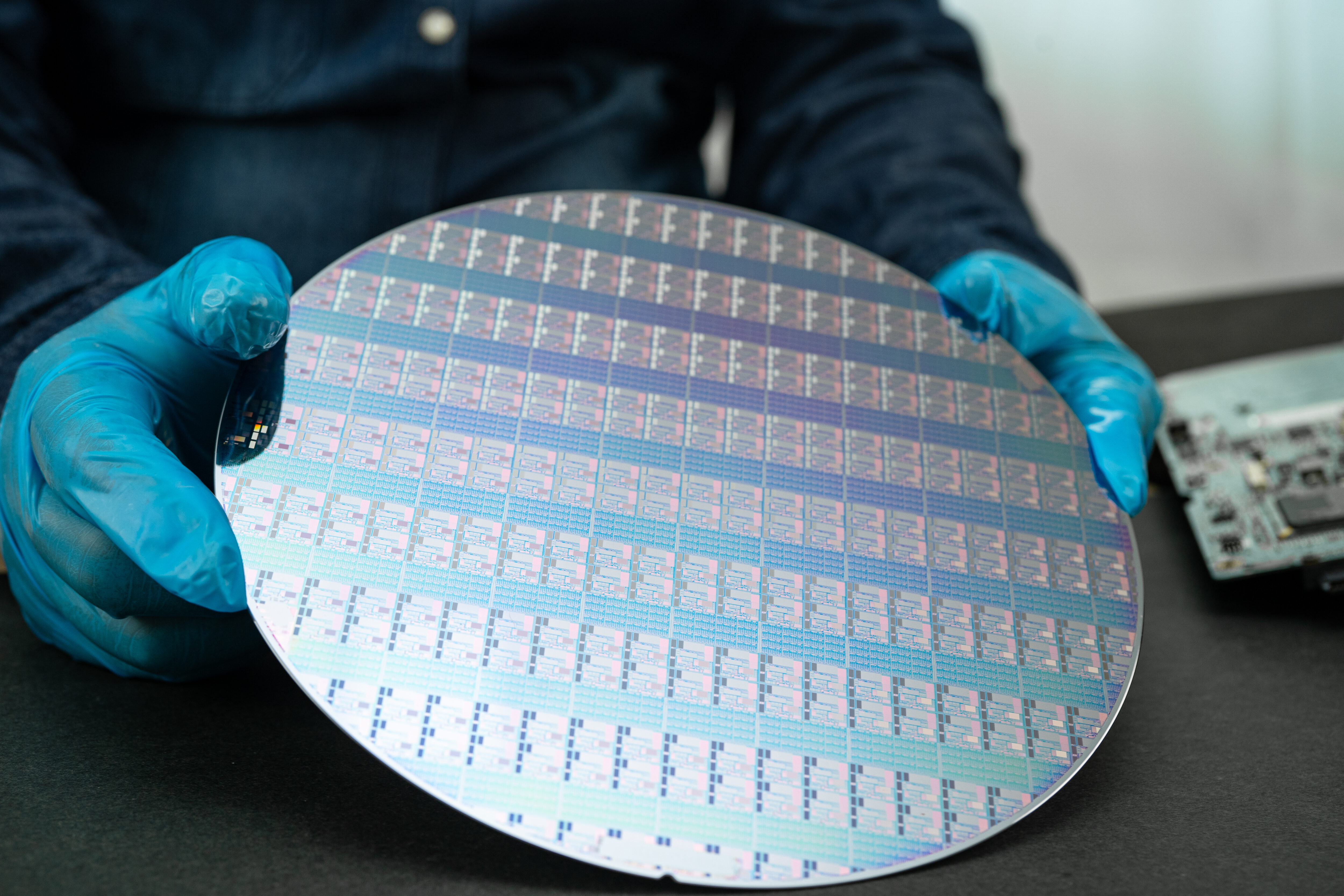
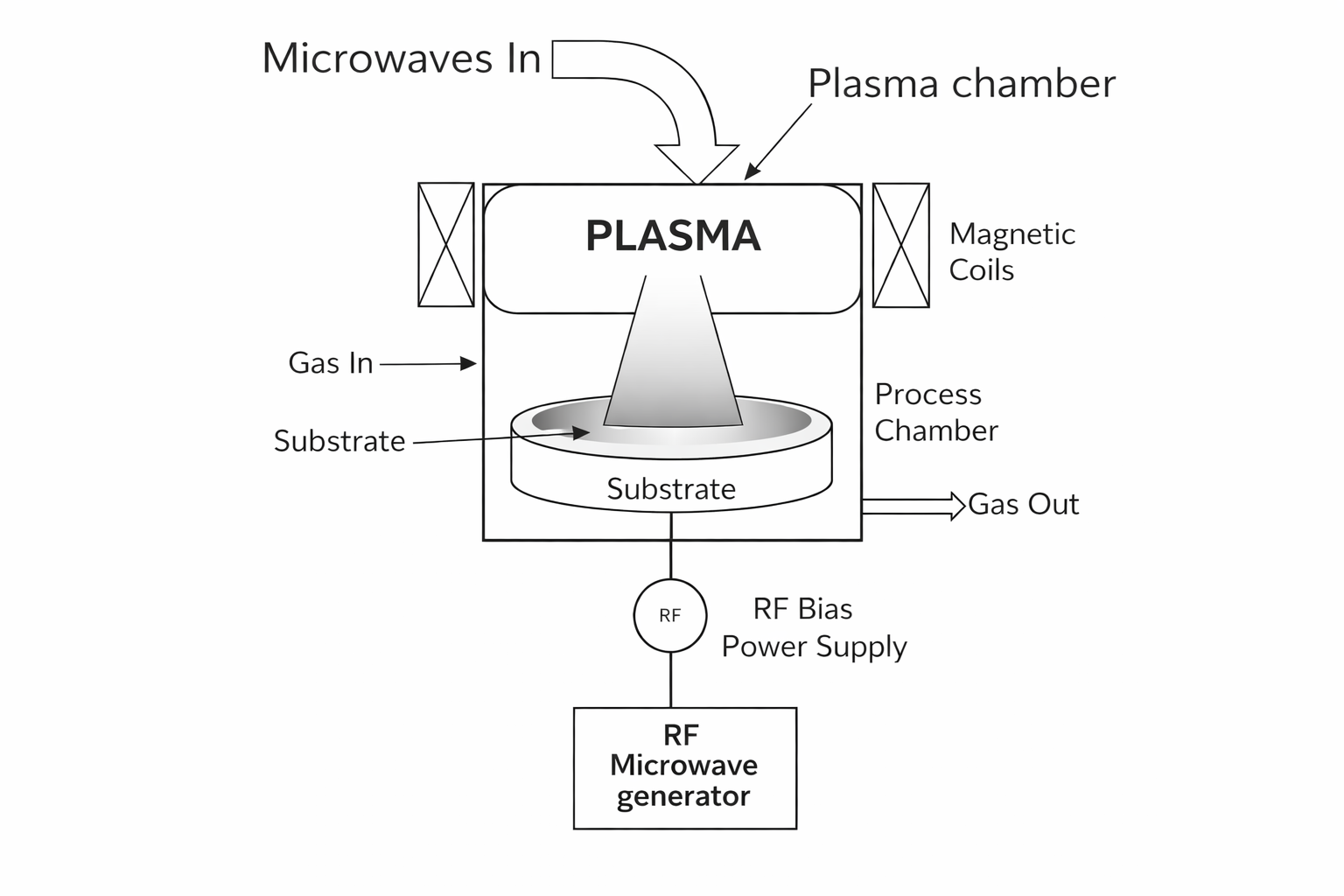
High-density plasma can be used to form fine patterns with precision and is particularly effective for etching high-aspect-ratio structures. This plasma etching technology has become one of the core technologies enabling semiconductor miniaturization.
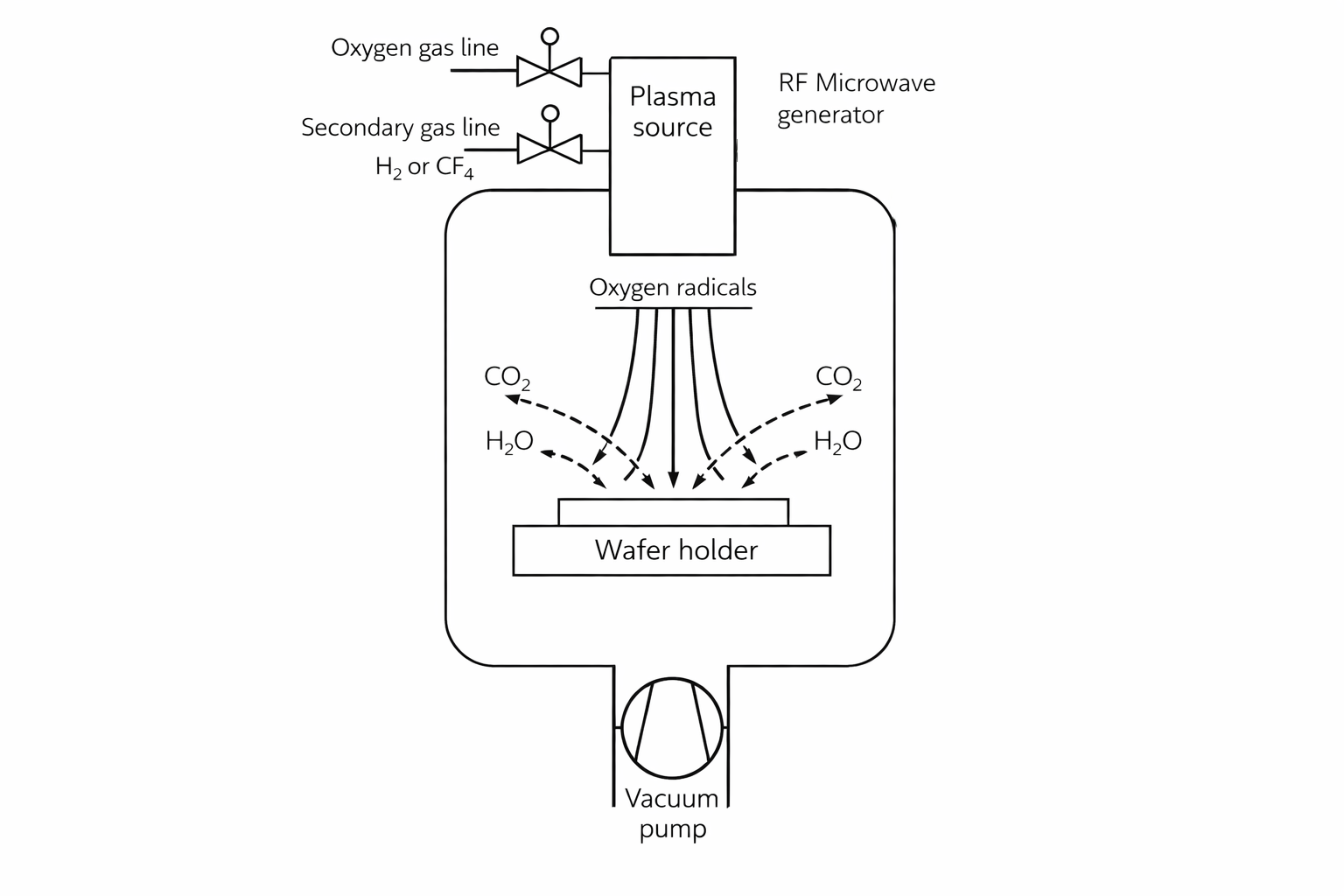
Plasma-enhanced chemical vapor deposition (PECVD) uses plasma to enable stable thin-film formation even at lower temperatures. RF microwave-based plasma can contribute to uniform film thickness and the formation of high-quality thin films.
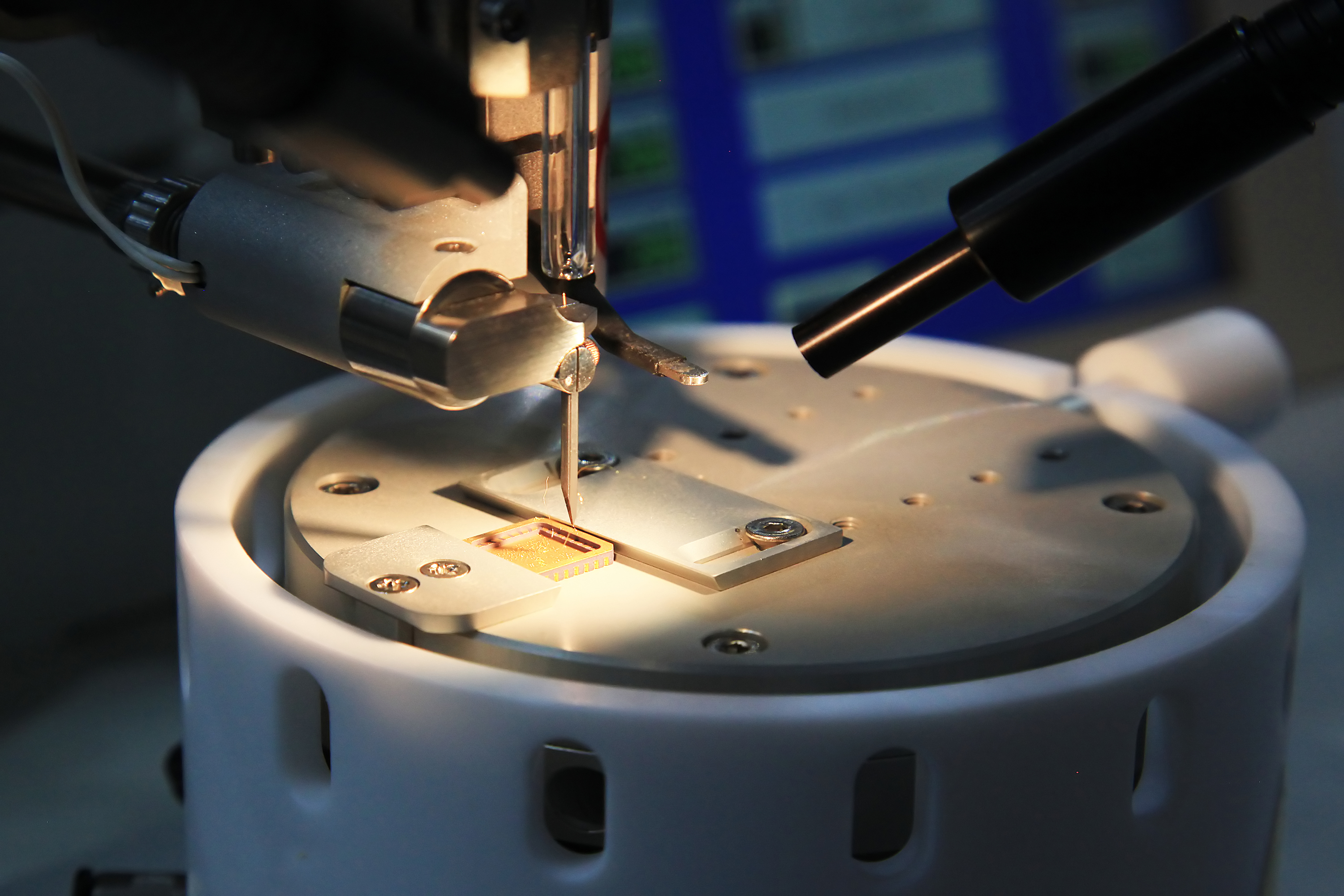
Plasma-based surface activation is used to improve material adhesion, control surface energy, and enhance electrical properties. In particular, microwave-based plasma enables uniform surface modification, making it suitable for high-precision processes.
The performance of plasma processes depends heavily on the stability and precise controllability of the RF power source used to generate the plasma.
A stable RF microwave generator plays a critical role in maintaining consistent plasma density, ion energy, and reaction uniformity, making it a key factor in ensuring process repeatability and equipment reliability. In advanced semiconductor processes, where nanometer-level control is required, fine RF power tuning is considered essential.
For engineering teams, this means that RF performance should be evaluated not only at the generator level, but also in terms of how it affects plasma behavior under actual process conditions.
In many cases, variability attributed to the process itself may also be influenced by how consistently RF power is delivered, controlled, and maintained over time. GaN solid-state RF microwave solutions offer a stronger foundation for this level of control and repeatability.
RFHIC’s GaN solid-state RF microwave generators are designed to overcome the limitations of conventional magnetron-based systems, delivering higher output stability, longer operational lifetime, and precise RF power control required for advanced semiconductor processes.
RFHIC works directly with engineering teams to evaluate actual process requirements and recommend the most suitable GaN RF microwave configuration.
If your goal is to improve process stability, reduce variation, or build a more optimized plasma environment, it is worth discussing your requirements with RFHIC early in the evaluation stage.
Request Consultation| Output Power | Application | Notes |
|---|---|---|
| 100 W | Research and Small-Scale Processes | Lab / R&D |
| 200 W | Pilot Processes | Pilot |
| 500 W | Volume Manufacturing | Production |
| 800 W+ | High-Density Processes | Advanced |
| Part Number | Min Freq (MHz) |
Max Freq (MHz) |
Output Power (W) |
VDC (V) |
Cooling | Dimension (mm) |
Operating Mode |
DC RF Efficiency (%) |
VSWR | Interface | Line Connection |
|---|---|---|---|---|---|---|---|---|---|---|---|
| RIM25100-20G | 2400 | 2500 | 100 | 50 | Air | 200×100×30 | CW/Pulse | 60 | 6:01 | RS-232 | D-Sub 7W2 |
| RIM25200-20G | 2400 | 2500 | 200 | 50 | Air | - | CW/Pulse | 60 | 6:01 | RS-232 | D-Sub 7W2 |
| RIM25500-20G | 2400 | 2500 | 500 | 50 | Water | - | CW/Pulse | - | - | RS-232 | D-Sub 7W2 |
| RCM25800-20G | 2400 | 2500 | 800 | 50 | Water | 320×150×51 | CW/Pulse | - | - | - | - |
| RCM251K6-20G | 2400 | 2500 | 1600 | 50 | Water | 200×362×53 | CW/Pulse | 57 | 6:01 | RS-232 | D-sub 5W5 |
RF microwave generator-based plasma technology is increasingly relevant to next-generation semiconductor processing, where plasma stability, controllability, and low contamination are critical to process performance.
As device structures continue to scale and process windows become tighter, RF power delivery is becoming a more important factor in enabling stable, repeatable, and high-precision plasma environments.
GaN solid-state RF systems are particularly well positioned to support this shift by providing the control and stability required in advanced manufacturing environments.
RFHIC supports semiconductor manufacturers with GaN solid-state RF microwave solutions designed around real process requirements.
Whether you are evaluating a new plasma platform, troubleshooting RF-related variation, or looking for a more stable and controllable solution, RFHIC can help you assess the right configuration for your process.
Request Consultation Explore Product LineupReferences
Lieberman, M. A., & Lichtenberg, A. J. (2005).
Principles of Plasma Discharges and Materials Processing (2nd ed.).
Wiley-Interscience.
Chen, F. F. (2016).
Introduction to Plasma Physics and Controlled Fusion.
Springer.
Coburn, J. W., & Winters, H. F. (1979).
Ion- and electron-assisted gas-surface chemistry—An important effect in plasma etching.
Journal of Applied Physics, 50(5), 3189–3196.
Ohring, M. (2002).
Materials Science of Thin Films (2nd ed.).
Academic Press.
May, G. S., & Sze, S. M. (2004).
Fundamentals of Semiconductor Fabrication.
Wiley.