Wireless Infrastructure
Meeting the continually evolving demands for 4G LTE & 5G wireless infrastructure applications with RFHIC's gallium nitride (GaN) on silicon carbide (SiC) technology solutions






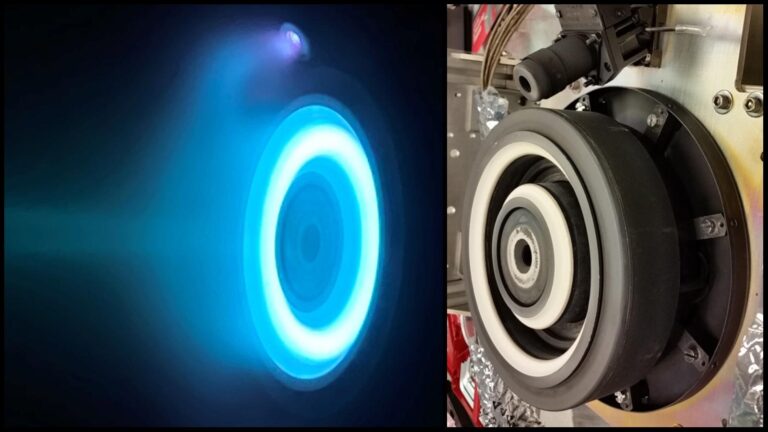
The space industry is expanding rapidly, with growing demand across satellite systems, deep-space exploration, and long-duration missions. The rise of small satellites, including CubeSats, has further accelerated the need for propulsion technologies that are both efficient and reliable over extended periods.
Traditional chemical propulsion systems can deliver high thrust, but they are limited in fuel efficiency and long-term operation. As a result, electric propulsion has emerged as a strong alternative for next-generation space missions, offering significantly improved fuel efficiency and operational longevity.
Among electric propulsion technologies, plasma propulsion is widely recognized for its high specific impulse and long operational life.
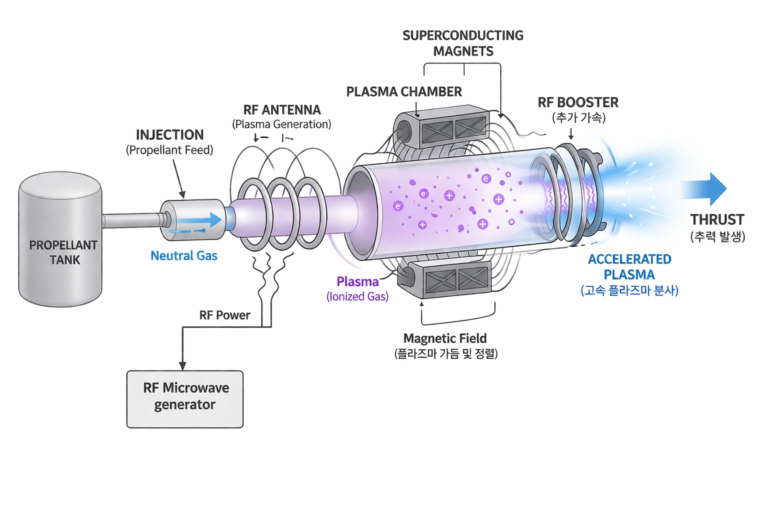
In these systems, propellant gas is ionized into plasma and then accelerated using electric or magnetic fields to generate thrust. This approach enables continuous thrust while significantly reducing propellant consumption compared to chemical propulsion.
Advances in RF and microwave plasma generation have further improved the precision and controllability of these systems, making them increasingly viable for practical space applications.
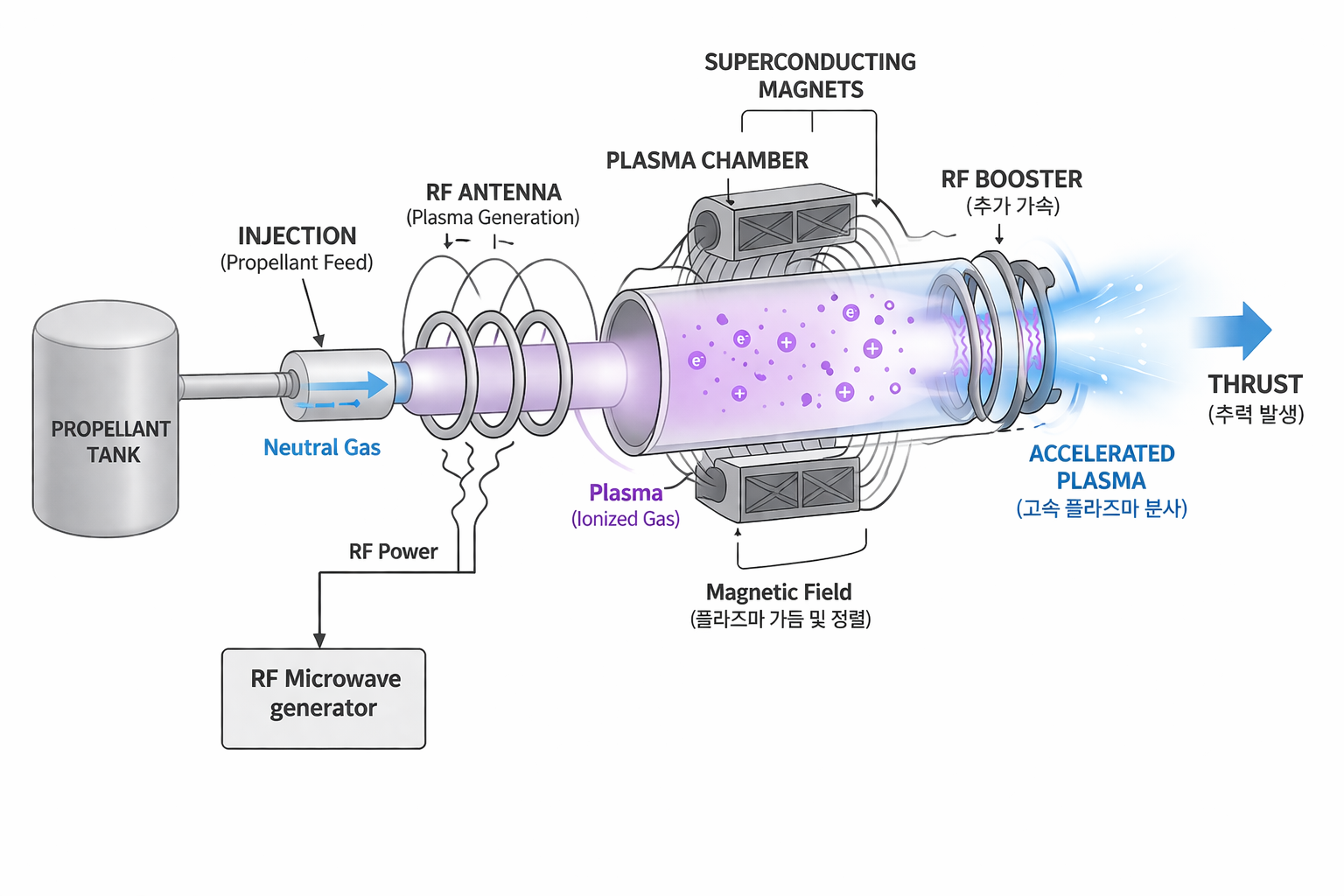
RF microwave generator-based plasma generation is gaining attention as a key enabling technology in electric propulsion systems.
These systems inject microwave energy into propellant gases, creating and sustaining plasma through electron acceleration and ionization. This allows for stable plasma discharge and efficient energy transfer within the propulsion system.
One of the most notable advantages of this approach is the ability to implement electrode-less plasma generation. By eliminating electrodes, the system avoids common issues such as erosion, contamination, and thermal degradation—factors that are especially critical in long-duration space missions.
In addition, precise RF power control enables stable plasma density and consistent energy delivery, both of which are essential for reliable propulsion performance.
RF microwave generator-based plasma propulsion can be applied across a range of space missions, including:
Microwave-based propulsion concepts, such as microwave electrothermal thrusters, have already demonstrated promising performance in experimental studies, supporting their potential as high-efficiency propulsion solutions.
| Output Power | Application | Notes |
|---|---|---|
| 200 W | Small Thrusters | CubeSat / R&D |
| 1 kW | Practical Satellite Systems | Operational Use |
| 5 kW+ | Large-Scale Missions | Deep Space Exploration |
As the space industry continues to grow, there is increasing focus on technologies that can deliver both high efficiency and long-term reliability.
Microwave-driven plasma generation is emerging as a strong candidate for next-generation electric propulsion systems. Its ability to produce high-density plasma with stable energy delivery makes it particularly well suited for advanced propulsion architectures.
In this context, RF microwave generator technology is expected to play a central role in enabling reliable, efficient propulsion for future space missions—especially those requiring long operational lifetimes and precise control.
References
Goebel, D. M., & Katz, I. (2008).
Fundamentals of Electric Propulsion: Ion and Hall Thrusters.
Jet Propulsion Laboratory, California Institute of Technology.
Lev, D. R., Myers, R. M., Lemmer, K. M., Kolbeck, J. A., Koizumi, H., Polzin, K. A., & Cappelli, M. A. (2019).
The technological and commercial expansion of electric propulsion.
Acta Astronautica, 159, 213–227.
Takahashi, K. (2019).
Helicon-type plasma thrusters.
Reviews of Modern Plasma Physics, 3(1), 3.
Lieberman, M. A., & Lichtenberg, A. J. (2005).
Principles of Plasma Discharges and Materials Processing (2nd ed.).
Wiley-Interscience.
Choueiri, E. Y. (2009).
New dawn for electric rockets.
Scientific American, 300(2), 58–65.
Charles, C. (2009).
Plasmas for spacecraft propulsion.
Journal of Physics D: Applied Physics, 42(16), 163001.
Shabshelowitz, A., et al. (2014).
Performance of a microwave electrothermal thruster.
Journal of Propulsion and Power.
ERC-ZARATHUSTRA Project
https://cordis.europa.eu/project/id/640012