Wireless Infrastructure
Meeting the continually evolving demands for 4G LTE & 5G wireless infrastructure applications with RFHIC's gallium nitride (GaN) on silicon carbide (SiC) technology solutions






leading pioneer in designing and manufacturing GaN RF and Microwave components & systems, has announced the release of their new brand.
“Our business has grown and evolved over the last 23 years, and we felt it was time to change,” said Samuel Cho, Founder, and CTO at RFHIC. We have refreshed our logo to reflect who we are today and to symbolize our future growth ambitions. After careful consideration, we chose a new logo and mark that reflects a more modern look and captures our vision to position RFHIC as the pioneers of GaN RF & Microwave technology for wireless communications, defense & aerospace, and RF energy (Industrial, Scientific, Medical) applications.
The company logo has been adjusted as follows:

From now on, RFHIC will use the following new corporate logo. At the same time, the old logo will still be used and will be phased out gradually in the following manner:
If supplementary paperwork and/or additional assistance for this minor change is required, please submit an inquiry through our Contact Us portal. We strongly advise customers who require assistance and/or supplementary paperwork to request within the 30 business day period to receive assistance promptly. After the 30 business day period, please understand response times may be delayed. We thank all of our customers for your time and continued support, and if you have any suggestions or questions, don’t hesitate to Contact Us through our website.
RFHIC (KOSDAQ: A218410) is a global leader in designing and manufacturing GaN RF & Microwave components and systems for applications in wireless communications, defense and aerospace, and RF Energy (Industrial, Scientific, and Medical) segments. We provide industry-leading solutions for gallium-nitride (GaN) transistors, high-power solid-state power amplifiers, and high-power microwave generator systems, all within our in-house production facility. We enlighten industries with RF and Microwave advancements. To expedite a future enhanced by technological innovation – to create a better connected, safer, and stronger world for generations. Learn more at www.rfhic.com.
The key to an efficient chemical vapor deposition (CVD) process relies heavily on the cleaning step. The cleaning step keeps the chamber and components inside free of unwanted particles and deposits. Over the last decade, the industry has moved from manual cleaning to in situ radio frequency (RF) plasma cleaning and remote plasma cleaning methods. Remote plasma cleaning using microwaves is relatively new. Still, its various advantages have increased yields, decreased system maintenance, and lowered the overall cost of maintaining and operating CVD equipment.
Chemical vapor deposition chambers are used to produce semiconductor components as well as lab-grown diamonds. The chamber must maintain a clean environment to provide optimal and reproducible products. One of the biggest challenges is that particles tend to contaminate the chamber walls harming the deposition process. Companies use toxic chemicals and gases to mitigate these challenges, which is becoming a major environmental concern. Due to the increasing impact of global warming, semiconductor companies are looking for alternative methods for the chamber cleaning process. Microwave plasma is the ideal solution for removing and sterilizing unwanted particles off the chamber walls and waveguides. A microwave plasma source provides a 99.9% removal efficiency of the reactant gas during the chamber cleaning process. This technology brings the million metric tons of carbon equivalent used for a chamber clean to negligible levels while enhancing efficiency and system throughput.
In situ, RF plasma sources have been used for various chamber cleaning applications, but they lacked enough yield to maintain feasibility due to the slow processing time. Also, RF plasma sources had trouble cleaning parts not directly exposed to the RF plasma source due to its anisotropic properties, resulting in leftover unwanted particles within the system and causing contamination during the deposition process. Lastly, the RF plasma technique would cause ion bombardment sputter, eroding the chamber and the components within the chamber – resulting in costly and time-consuming maintenance.
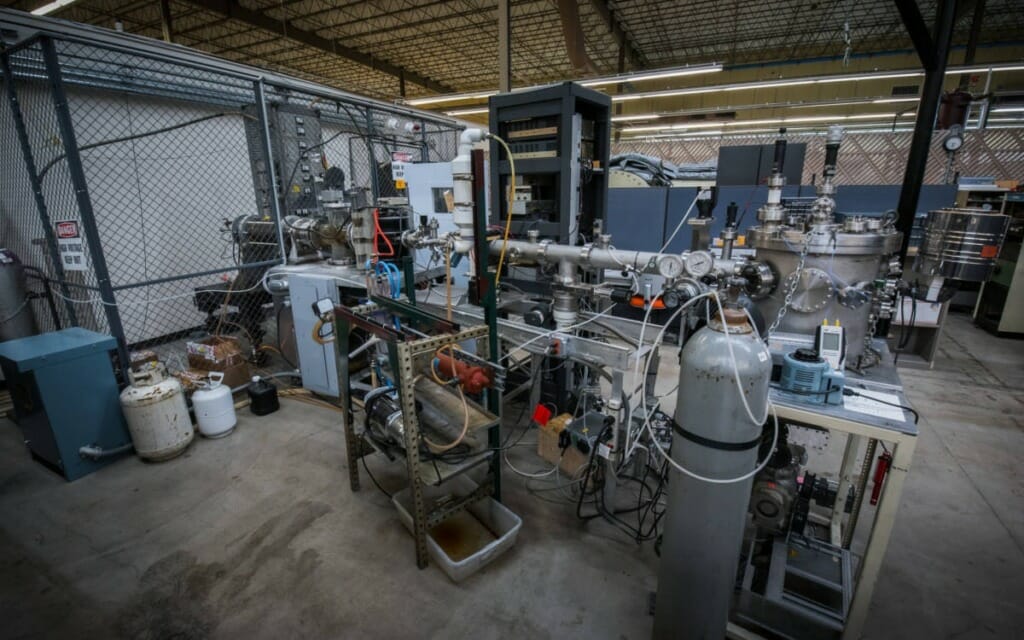
Therefore, chamber cleaning using microwave plasma is a more efficient solution to this problem since the chamber walls could be cleaned without direct exposure to the plasma source due to the unique properties of microwaves. Also, microwave plasma cleaning is a purely chemical reaction causing no ion bombardment, resulting in minimal erosion of the chamber walls and components.
RFHIC introduces its latest Direct Power series featuring a portable and compact 3kW GaN solid-state industrial microwave generator operable both in 900-930MHz (RIU093K0-40TG) and 2400-2500MHz (RIU243K0-40TG)
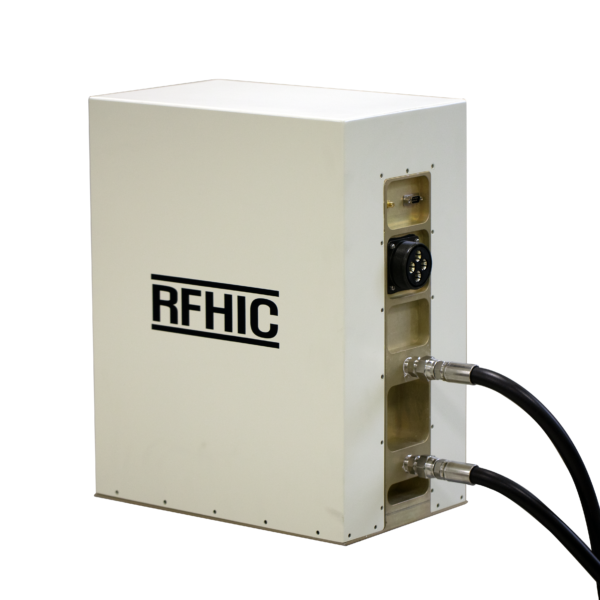
Both compact generators are designed with an internal waveguide allowing users to mount them directly on the CVD chamber lid, thus eliminating the need for bulky and costly waveguides.
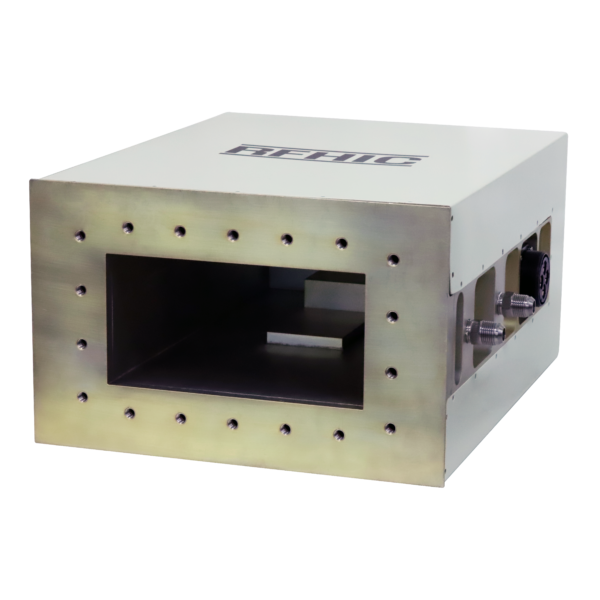
The RIU093K0-40TG (3kW, 900-930MHz) and RIU243K0-40TG (3kW, 2.45GHz) are turn-key GaN solid-state microwave generator solutions that come equipped with a 3kW SSPA head, a 380 VAC power supply unit, a control module, and cables and can operate at both continuous and pulse operations. Both generators have a remote architecture allowing the 3kW SSPA head to be installed apart from the power supply. This separation allows for greater system flexibility and simplifies system integration.
Industrial Microwave Generators for Next Generation Waste Gasification
Our society produces over 2 billion tons of waste per year, which is expected to grow by over 70% by the next five years – to put that into perspective, that’s a line of garbage trucks stretching from San Francisco to New York City every single day.
With this issue, companies have long sought ways to turn all this waste into energy by burning our trash – but this method is said to strike major environmental drawbacks. So what is the better solution? – Gasification

Gasification is a technological process that converts any carbonaceous (carbon-based) raw material, such as coal, into fuel gas, also known as synthesis gas (syngas for short) – a process said to be economical and eco-friendly. This synthetic gas can then be converted into various end products like electricity, hydrogen fuel, ethanol, and more.
Microwave energy can potentially promote gas production during biomass pyrolysis or gasification based on its advantageous features, such as rapid and selective heating. Microwave energy can be used to generate microwave plasma, which thus can be used to convert biomass into renewable biofuels.
Our customer needed a high-power microwave source that could be used to generate a stable source of plasma intended for disposing of solid waste materials. Discover how RFHIC’s GaN solid-state microwave solutions meet their needs!
Our customer is a globally renowned company specializing in developing green plasma energy to industrialize plasma application technology. The company operates a world-class plasma gasification plant generating up to 600kg of green hydrogen production per day to be reused for electricity and other forms of green gases.
Plasma energy can dispose of both biomass and harmful wastes and convert them into an efficient form of energy – called syngas. The produced syngas can then be used to generate electricity, fuel combustion systems, and produce hydrogen.
The customer used a 30kW magnetron system to generate plasma for their waste gasification system. Unfortunately, the company had major reliability and safety issues due to the magnetron’s short life span and high voltage characteristics. The system would shut down every couple hours due to a faulty magnetron head. Also, having the magnetron supplier overseas made the process even more inefficient and costly.
Due to the system’s frequent shutdowns, the company was having trouble creating a reliable source of plasma and getting its system to scale. The company was looking for a microwave solution to generate and obtain plasma reliably while withstanding those high temperatures.
RFHIC offered a 12kW GaN solid-state microwave generator (RIK2512K-40TG_H) operable from 2400 to 2500 MHz. The RIK2512K-40TG_H is a solid-state microwave power source fabricated using RFHIC’s cutting-edge gallium-nitride (GaN) on silicon-carbide (SiC) HEMT. The RIK2512K-40TG_H comes fully equipped with a 3-phase 380VAC power supply unit, a control module, and four SSPA shelves.
Alternative to conventional magnetron-type microwave power supplies, RFHIC’s RIK2512K-40TG_H allows precise digital controllability of the frequency and phase. These key features allowed our customers to generate and obtain a more uniform and deeper plasma penetration, achieving higher volumes of waste in a shorter time.
Although the acquisition cost of RFHIC’s GaN solid state MWG was higher than the magnetron, RFHIC’s GaN solid state MWG ended up being an economical alternative when considering all variable costs (ex., longer lifetime, less maintenance, digital control capability = better quality products, etc.)
There are many use cases for microwaves in semiconductor applications, from annealing to etching to remote plasma deposition. The possibilities are endless. Our customers in the semiconductor industry are looking for reliable microwave sources that adapt to the changes in how semiconductors are manufactured. For the most part, magnetron has been the main source for various semiconductor applications in lower frequencies. However, the age has come for solid-state technology to help engage the ever-evolving semiconductor market.
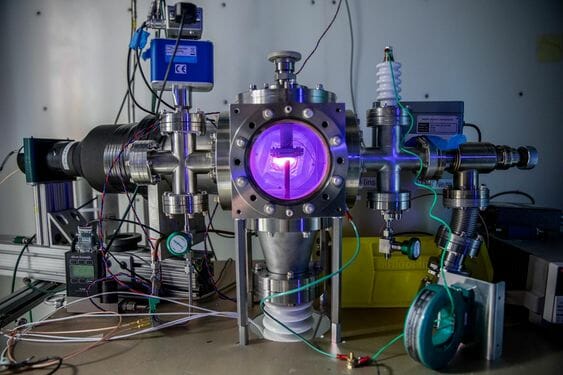
The thermal process has various roles within the semiconductor world. It can help wafers put back into correct formation and prepare them to receive new materials. Many frequencies are used for this microwave heating application, most commonly 915MHz and 2.45GHz. Some have shown theoretical advantages of using 5.8GHz due to frequency influence on the dielectric properties of the materials. Also, frequency has an inverse relationship to penetration depth, meaning that the higher the frequency, the more the penetration depth decreases. This could be ideal for selective heating of very thin layers deposited onto a substrate. There are various methods of heating using a microwave. The two main methods are variable frequency microwave and microwave induction heating. These heating methods have tremendous advantages in the semiconductor process due to the control of penetration depth and the ability to heat materials almost five times faster than conventional radiant methods. The variable frequency microwave method sweeps across the bandwidth very fast (in milliseconds) to create uniform heating without getting the concentrated hot spots like you would on your microwave ovens.
The other method is induction heating, which is very similar to the induction cooktop, yet the frequency is much higher. Microwave induction heating, also known as electromagnetic induction heating (EMIH), can be advantageous over conventional RTP chambers that use external radiant heat sources in the sense that the presence of insulating layers will not hinder the heating because the wave transmits through the insulator and directly into the material that needs to be heated.
For the most part, the plasma-assisted process is still considered one of the thermal processes. The difference is that it uses plasma and its unique ability to ionize gas for deposition and/or etch away unwanted materials. On this topic, the focus is on microwave plasma; higher frequency plasma has higher plasma density and lower penetration depth. There are many forms of deposition in the semiconductor industry. Most are utilized for thin film deposition on wafers in various formats. Many of these processes are different from each other in how the chemical reaction is initiated.
Currently, many companies are trying to utilize the solid state’s advantage for microwave plasma-assisted CVD (MPCVD) to produce diamond gemstones. Unlike many semiconductor processes, where the longest processes may not exceed one day, continued operation for 5 to 10 days is necessary for diamond growth. During that time, any equipment failure may jeopardize the batch completely. It is also important for semiconductor equipment to operate at little to no margins every time it is used. This type of operation may be difficult for magnetron sources where frequency may shift depending on the lifespan or even the condition it operates. SSPA can mitigate such issues with precise frequency control to match the recipe required for the specific process.
There are various ways GaN solid-state technology can play in the semiconductor equipment market. It creates a circular supply chain where the materials produced by the equipment are utilized to power the equipment. RFHIC is pursuing to take part in improving and enhancing the semiconductor industry with our GaN solid-state industrial microwave generators.
Discover how we helped a major food research facility process better quality “ready-to-eat” meals with faster throughput thanks to our GaN solid-state microwave technology for microwave cooking applications.
Heating is known to be one of the most effective means of killing spoilage and pathogenic microorganisms to extend the shelf life of foods. Today, “ready-to-eat” shelf-stable foods are generally packaged in an oxygen-free environment to eliminate chemical reactions from occurring, thus stopping or prolonging the food’s shelf stability.
The traditional thermal process for packaged foods generally uses a retort system, which utilizes pressurized steam at high temperatures to eliminate spoilage and viral pathogens.
However, this usually takes several hours and tends to overcook the product – resulting in a loss of flavor, texture, color, and nutrients from the food.
As a result, our customer was looking for a new and improved method of thermally processing the “ready-to-eat” meals using our GaN solid-state industrial microwave generators.
915MHz was chosen due to its deeper penetration capabilities allowing it to cook the food more uniformly. Due to the delicate nature of the product and process, the customer required a single-mode cavity to produce a more stable heating pattern.
To meet our customer’s needs, we designed a compact and portable microwave generator solution equipped with an internal waveguide allowing the customer to connect the generator to a horn antenna inside the chamber. This allowed our customers to eliminate bulky and costly waveguides from their entire system, saving high costs and floor space. The generator was also able to cut processing times by over 50% compared to conventional processing and produce higher-quality foods in flavor, texture, color, and nutrients.
RFHIC provided our RIU093K0-40TG microwave generator solution operable from 900 to 930 MHz with a max output power of 3kW. The RIU093K0-40TG is a remote type of microwave generator consisting of a separate SSPA head, a 380 VAC power supply unit, a control module, and RF cables. The remote architecture allows for greater system flexibility and simplified system integration.
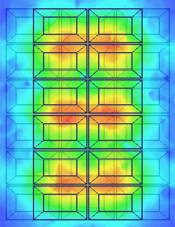
915MHz heat distribution model
With the transition to a microwave solution, our clients could optimize the quality of their end products while significantly lowering costs.
For more information, don’t hesitate to get in touch with us here. Contact Us
How Microwave Technology is Used for Foaming of Polymer Materials
Our customer is an integrated and innovative solution provider of plastic resin & synthetic fiber manufacturing. This corporation has over 300 employees and generates more than $200 million in annual sales (USD). The customer is a global leader in manufacturing a foam-type thermosetting resin with a unique open-cell structure that provides excellent sound absorption, insulation, and durability.
The customer was already using multiple machines for manufacturing their products, including a long conveyor tunnel equipped with multiple magnetrons to foam and expand their thermosetting resin material used for construction, transportation, and industrial applications.
The melamine foam has a unique three-dimensional hexagonal reticular structure providing an open-cell foam, unlike many other conventional polymeric foams. It is mainly known for its excellent sound absorption and fire resistance properties making it useful for various industrial applications.
The manufacturing process consisted of three main microwave heating sections:
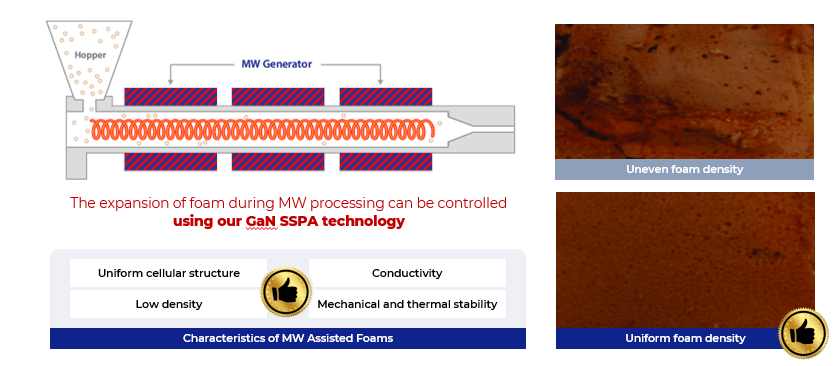
The customer was having difficulty expanding the melamine foam and heating it uniformly. The foam would heat the exterior more than the interior with its current solution, creating an uneven cellular structure. This problem led to longer processing times, and overall uneven-quality foam.
The customers were looking for a solution to expand and heat the melamine foam more uniformly and quickly. We believed our GaN solid-state industrial microwave solutions would be great for them to heat the melamine foam more uniformly while shortening processing times.
RFHIC offered our compact 3kW, GaN solid-state industrial microwave generator solution to replace their current magnetron technology. Doing so allowed them to test and see which frequency, power level, and signal source worked best for each section, allowing them to create the perfect “recipe.”
Having the customer integrate our 3kW, Industrial Microwave generator system allowed them to save tremendous costs from the following:
Due to the built-in internal waveguide, our customer could get rid of bulky, long, and expensive external waveguides. This allowed them to directly attach our microwave generators to their current system allowing for better heat distribution and simplified system integration.
For more information, don’t hesitate to get in touch with us here: Contact Us
RFHIC and MaxLinear Achieve Breakthrough Linearization Performance for Ultra-Wideband 5G New RadioMaxLinear transceivers and linearization technology combine with RFHIC’s power amplifiers to exceed 3GPP requirements for 5G New Radio (NR)
CARLSBAD, CA/ Anyang, South Korea – August 10, 2021 – MaxLinear, Inc. (NYSE: MXL), a leading provider of radio frequency (RF), analog, digital and mixed-signal integrated circuits, and RFHIC (KOSDAQ: 218410), a leader in the design and manufacture of high-performance active RF and microwave components and hybrid modules recently verified that RFHIC’s Gallium Nitride (GaN) transistor for 5G macro base stations and hybrid power amplifier module (PAM) for 5G massive MIMO base stations achieved breakthrough linearization performance when combined with MaxLinear’s MaxLIN linearization technology, exceeding 3rd Generation Partnership Project (3GPP) requirements for ultra-wideband 5G New Radio (5G NR).
RFHIC and MaxLinear are collaborating to optimize the combined performance of power amplifiers, transceivers, and linearization at key 5G bands (3.4 to 3.8GHz and 3.7 to 3.98GHz). The collaboration entails RFHIC’s highly efficient GaN solutions for 5G telecom infrastructure, MaxLinear’s high-performance transceivers, and MaxLinear’s ultra-wideband linearization solution (MaxLIN), achieving outstanding efficiency and linearity performance.
MaxLinear’s transceiver portfolio includes:
These transceivers are software compatible, creating a single platform solution that customers can leverage for any application. By providing the transceiver and the linearization solution, along with test data that includes the full transmit lineup, MaxLinear customers can move quickly to production without performance surprises.
RFHIC’s GaN transistors for 5G macro base stations, ID36411D operating at 3.4 to 3.8GHz and ID38411DR operating at 3.7 to 3.98GHz, are designed to achieve the highest efficiency with 100MHz, 200MHz, and 300MHz IBW. The ID36411D achieves over 47% power efficiency for an average output power of 47.41dBm (55W). MaxLIN improves linearity by over 25dB to exceed 3GPP and Federal Communications Commission (FCC) requirements with margin.
“Our GaN power amplifier solution will accelerate the size reduction of 5G base station equipment because of its outstanding power efficiency and high integration. Also, its breakthrough wide bandwidth performance will enable one radio unit to support multiple wireless service providers,” said Sam Kim, Vice President at RFHIC.
“Combining RFHIC technology with MaxLinear transceivers and MaxLIN ultra-wideband linearization provides the highest performance solution available on the market for wideband use cases, such as the crucial C-Band recently auctioned in the U.S.,” said Helen Kim, Vice President of MaxLinear’s Wireless Technologies & IP. “With our automated lineup optimization tool, we can quickly customize the full transmit line-up and provide our customers a market-ready solution in days, rather than months.”
The collaboration of RFHIC and MaxLinear will support all global sub-6GHz 5G spectrums and contribute to the continued innovation of conventional base station equipment and O-RAN technology.
To learn more about RFHIC and its products, please visit www.rfhic.com. To learn more about MaxLinear and its products, please visit www.maxlinear.com.
MaxLinear, Inc. (NYSE: MXL) is a leading provider of radio frequency (RF), analog, digital and mixed-signal integrated circuits for the connectivity and access, wired and wireless infrastructure, and industrial and multimarket applications. MaxLinear is headquartered in Carlsbad, California. For more information, please visit www.maxlinear.com. MxL and the MaxLinear logo are trademarks of MaxLinear, Inc. Other trademarks appearing herein are the property of their respective owners.
RFHIC Corporation is a leader in designing and manufacturing high-performance active RF & Microwave components and hybrid modules for telecom infrastructures, defense industries, and customized solutions. RFHIC Corporation is headquartered in Anyang, South Korea, and its US Corporation is in Morrisville, NC. For more information, please visit www.rfhic.com. RFHIC logo is a trademark of RFHIC Corporation. Other trademarks appearing herein are the property of their respective owners.
This press release contains “forward-looking” statements within the meaning of federal securities laws. Forward-looking statements include, among others, statements concerning or implying future financial performance, anticipated product performance and functionality of our products or products incorporating our products, and industry trends and growth opportunities affecting MaxLinear, in particular, statements relating to MaxLinear’s ultra-wideband linearization solution (MaxLIN) and MxL155x and MxL16xx 400MHz transceivers, current or future benefits of collaboration with RFHIC Corporation, functionality, integration, interoperability, performance, and the benefits of the use of such products and technologies. These forward-looking statements involve known and unknown risks, uncertainties, and other factors that may cause actual results to differ materially from any future results expressed or implied by these forward-looking statements. We cannot predict whether or to what extent these new or existing products will affect our future revenues or financial performance. Forward-looking statements are based on management’s current, preliminary expectations. They are subject to various risks and uncertainties that could cause results to differ materially from those described in the forward-looking statements. Forward-looking statements may contain words such as “will be,” “will,” “expect,” “anticipate,” “continue,” or similar expressions and include the assumptions that underlie such statements. The following factors, among others, could cause actual results to differ materially from those described in the forward-looking statements: intense competition in our industry and product markets; risks relating to the development, testing, and commercial introduction of new products and product functionalities; the ability of our customers to cancel or reduce orders; and uncertainties concerning how end-user markets for our products will develop. Other risks potentially affecting our business include risks relating to acquisition integration; our lack of long-term supply contracts and dependence on limited sources of supply; potential decreases in average selling prices for our products; impacts from public health crises such as the Covid-19 pandemic or natural disasters; and the potential for intellectual property litigation, which is prevalent in our industry. In addition to these risks and uncertainties, investors should review the risks and uncertainties contained in MaxLinear’s filings with the United States Securities and Exchange Commission, including risks and uncertainties arising from other factors affecting the business, operating results, and financial condition of MaxLinear, including those set forth in MaxLinear’s most recent Annual Report on Form 10-K for the year ended December 31, 2020 and Quarterly Report on Form 10-Q for the quarter ended June 30, 2021, in each case as filed with the Securities and Exchange Commission. All forward-looking statements are qualified in their entirety by this cautionary statement. MaxLinear is providing this information as of the date of this release and does not undertake any obligation to update any forward-looking statements contained in this release as a result of new information, future events, or otherwise.
This press release contains forward-looking statements involving risks and uncertainties, both known and unknown, that may cause actual results to differ materially from those indicated. Actual results may differ materially due to a number of factors, including the risk that we may be unable to manufacture these new products with sufficiently low cost to offer them at competitive prices or with acceptable margins; the risk we may encounter delays or other difficulties in ramping up production of our capacity to supply these products; customer acceptance of our products; the rapid development of new technology and competing products that may impair demand or render RFHIC’s products obsolete; and other factors discussed in RFHIC’s filings with the Korean Stock Exchange Commission, including its report on Form 10-K for the year ended June 28, 2020, and subsequent filings.
MaxLinear, Inc. Press Contact:
Debbie Brandenburg
Sr. Marketing Communications Manager
Tel: +1 669-265-6083
dbrandenburg@maxlinear.com
MaxLinear, Inc. Corporate Contact:
Helen Kim
Vice President, Wireless Technologies & IP
Tel: +1 760-692-0711
RFHIC Corp. Corporate Contact:
Sam Kim
Vice President, Business Development
Tel : +1 919-655-1131
Sam.Kim@rfhicusa.com
Anyang, South Korea, December 07, 2020 – RFHIC Corporation (KOSDAQ:218410), a global leader in designing and manufacturing GaN RF & Microwave solutions.
One thing is for sure, is that COVID-19 has had a direct and indirect impact on all of us in the way we live and the way we work. With that being said, RFHIC remains committed to pushing forward and continuing our focus strategies for next-generation RF & Microwave technology in 5G, Defense, and RF Energy. RFHIC is determined to get through these challenging times as a much stronger company- to be more agile and well-positioned within the RF & MW market.
If you have a technical problem or a question about a product, or if you need anything else, contact us and we’ll assist you in the best way possible.
We’re committed to being a great partner and GaN solutions provider with the goal of creating a better and faster world.
RFHIC Corporation provides innovative GaN solutions that transform how the world operates, communicates, and protects. Our cutting edge GaN technology is the core foundation of all our inventions for creating a better, faster, and more efficient world. As a global leader in designing and manufacturing GaN RF & Microwave components, we envision spurring a new era of high-powered and reliable devices for the next big change in industrial, cellular, and defense technology. Headquartered in Anyang, South Korea.
RFHIC has a US sales office in Morrisville, North Carolina, and sales distributors throughout North America, Europe, and Asia. RFHIC is an ISO9001 (International quality standard) and ISO14001 (Environmental management standard) certified company, providing reliable and dependable products worldwide.
Media Contacts:
Grace Cho
Grace.cho@rfhic.com
RFHIC’s 6kW, solid-state microwave generator provides enhanced performance for various 2.4-2.5 GHz industrial, scientific, and medical (ISM) applications. The 6kW, gallium-nitride (GaN) solid-state microwave generator is designed as a one-to-one replacement of bulky and unreliable tube-based power systems (magnetrons, klystrons, etc.) for various applications such as:
RFHIC’s compact and lightweight RIU256K0-40TG (6kW, GaN solid-state microwave generator) generator operates from 2.4 to 2.5 GHz, combining four 1.6 kW gallium-nitride (GaN) power amplifiers (PAs) into a remote, solid-state head. The complete microwave generator system comes with a power supply unit, solid-state power amplifier (SSPA) head, cable assembly, and waveguide converter. (see Figure 1).

The solid-state power amplifier (SSPA) supports both CW and pulse operation and can be customized to end-user application requirements. With an adjustable power range from five to 100 percent of rated output, the RIU256K0-40TG (6kW, GaN solid-state microwave generator) maintains high system efficiency at both low and high power (see Figure 2).
Each of the four gallium-nitride (GaN) power amplifiers (PAs) in the generator uses RFHIC’s high-performance gallium-nitride (GaN) on silicon-carbide (SiC) transistor technology, which provides wide bandwidth, high efficiency, high breakdown voltage, and reduces the overall size of the system. The RIU256K0-40TG (6kW, GaN solid-state microwave generator) uses 200 W transistors (IE24200P), which have a saturated output power of 230 W and 74 percent drain efficiency at 50 V bias. The fully matched transistors are integrated with DC-blocking capacitors on both RF ports to simplify system integration.
Historically, numerous RF energy applications relied on vacuum tubes or magnetrons as their primary power source. However, these systems came with notable drawbacks in terms of frequency, power, and phase control. In contrast, the RIU256K0-40TG (6kW, GaN solid-state microwave generator)incorporates RFHIC’s advanced drive and control module, enabling precise adjustment of both output frequency and power. As a result, this generator produces an exceptionally clean signal with minimal noise and spurious interference, far surpassing the performance of traditional magnetrons (refer to Figure 3).
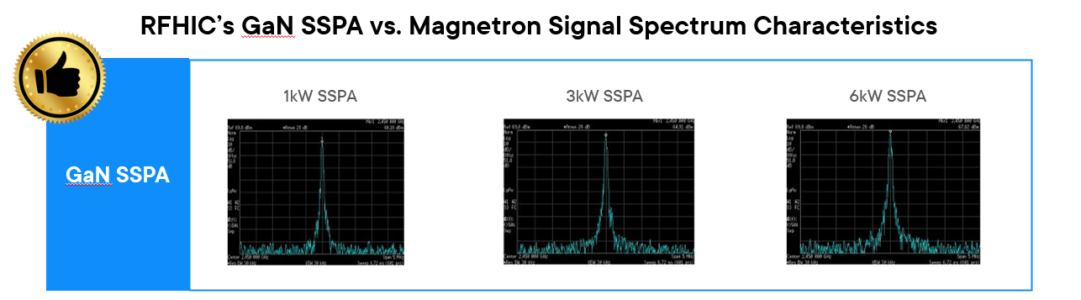
Another significant advantage lies in the ability to instantly generate full power without any warm-up time. In contrast, tubes often have short lifespans, frequently less than 6,000 hours. This not only leads to downtime but also escalates operating costs. The RIU256K0-40TG (6kW, GaN solid-state microwave generator) boasts an impressive lifespan ranging from 50,000 to 100,000 hours, depending on operating conditions. This extended longevity translates to substantial cost savings.
Unlike magnetrons and other tube-based systems reliant on a single power source, the RIU256K0-40TG (6kW, GaN solid-state microwave generator) features a configuration with four robust GaN solid-state power amplifiers (SSPAs). This design ensures graceful degradation in case one of the PAs encounters an issue. In contrast, tube-based systems necessitate high-voltage power supplies within the generator, which are prone to arcing. The GaN solid-state power amplifier (SSPA) operates at a safer voltage of 50 V.
Furthermore, the RIU256K0-40TG implements efficient water cooling to eliminate the need for large metal heat sinks, thus reducing the overall size of the generator. This innovative approach allows the SSPA to seamlessly integrate with existing cooling infrastructure in tube-based systems, resulting in cost savings during installation and operation. The system incorporates multiple sensors to monitor water flow rate, SSPA temperature, and VSWR. In the event of abnormal operation, the system automatically initiates a shutdown and alerts the user, safeguarding the generator from damage.
The RIU256K0-40TG also offers user-friendly controls with an LCD touch-screen and jog wheel, granting complete access to system controls, sensors, and alarms. Additionally, comprehensive monitoring and management are accessible through a laptop or remote PC. For added convenience, the system can be controlled remotely via PLC, CAN, or Bluetooth, providing users with versatile options for system management.
The RIU256K0-40TG (6kW, GaN solid-state microwave generator) is a self-contained, rack-mounted system comprising two main components:
GaN Solid-State Power Amplifier (SSPA) Head with Isolator: This unit measures 43.2 cm in width, 90.2 cm in length, 23.8 cm in height, and weighs 54.2 kg.Power Supply: The power supply unit has dimensions of 48.3 cm in width, 43.2 cm in length, and 17.7 cm in height, with a weight of 29 kg.The power supply operates on a three-phase, 380~480 VAC and generates the required 50 V bias for the gallium-nitride (GaN) on silicon-carbide (SiC) transistors. Notably, the power supply incorporates three rectifier modules designed for load sharing, hot-swappability, and n+1 redundancy. This means that if one of the power modules fails, the SSPA can continue to operate without the need to replace the entire generator.
To achieve a 6 kW continuous wave (CW) output, four 1.6 kW SSPAs are combined using RFHIC’s four-way waveguide combiner. Operating within the 2.4 to 2.5 GHz frequency range, the WR340 combiner offers exceptional performance, with a maximum insertion loss of 0.1 dB, a 1.1:1 voltage standing wave ratio (VSWR), and an imbalance of less than 3 degrees among its ports.
Additionally, the generator is designed with scalability in mind. Users have the flexibility to integrate RFHIC’s commercial off-the-shelf power amplifiers (PAs) without the need for manual phase synchronization. This adaptability maximizes amplifier utilization, reduces capital expenses, and shortens development timelines.
For any inquiries or questions, please complete the contact form, and a sales representative will be readily available to assist you.
RFHIC’s Subsidiary Company B&C Tech has Signed a Contract with NH Investment & Securities
Anyang, South Korea, November 17, 2020 – RFHIC Corporation (KOSDAQ:218410), a global leader in designing and manufacturing GaN RF & Microwave solutions and its subsidiary Metal Life recently acquired B&C Tech, a pioneer in aluminum dip brazing technology designed for military antennas and air conditioning applications.
B&C (Brazing and Communications) Tech today announced a contract with NH Investment & Securities as a host company and is preparing for full-scale listing on the KOSDAQ by the end of 2022. With the merger and acquisition (M&A) of Metal Life, a subsidiary of RFHIC, the company is expected to expand its overseas defense sales.
An official from NH Investment & Securities said, “If B&C Tech, which has grown through a partnership with LIG Nex1, generates synergy through RFHIC’s overseas defense network, it will be possible to grow a virtuous cycle that can increase its competitiveness in the domestic defense industry.” “In addition, if sales continue to expand to the private sector, which is about 10% of the current total sales, it will be possible to be listed as a company attracting attention in the market,” he said.
B&C Tech is expected to generate sales of 24 billion won this year and is planning to develop overseas markets with the goal of expanding its overseas defense and civilian sector sales to 50% of total sales.
RFHIC Corporation provides innovative GaN solutions that transform how the world operates, communicates, and protects. Our cutting edge GaN technology is the core foundation of all our inventions for creating a better, faster, and more efficient world. As a global leader in designing and manufacturing GaN RF & Microwave components, we envision spurring a new era of high-powered and reliable devices for the next big change in industrial, cellular, and defense technology. Headquartered in Anyang, South Korea.
RFHIC has a US sales office in Morrisville, North Carolina, and sales distributors throughout North America, Europe, and Asia. RFHIC is an ISO9001 (International quality standard) and ISO14001 (Environmental management standard) certified company, providing reliable and dependable products worldwide.
Media Contacts:
Grace Cho
Grace.cho@rfhic.com